
Sam Antar was the first professional to report on the Letitia James mortgage fraud case because he was the person who uncovered it. Although the media tries to report on the case, they keep getting it wrong, and it is so simple for a forensic accountant like Sam to point us back to the documents (i.e. evidence) to get it right.
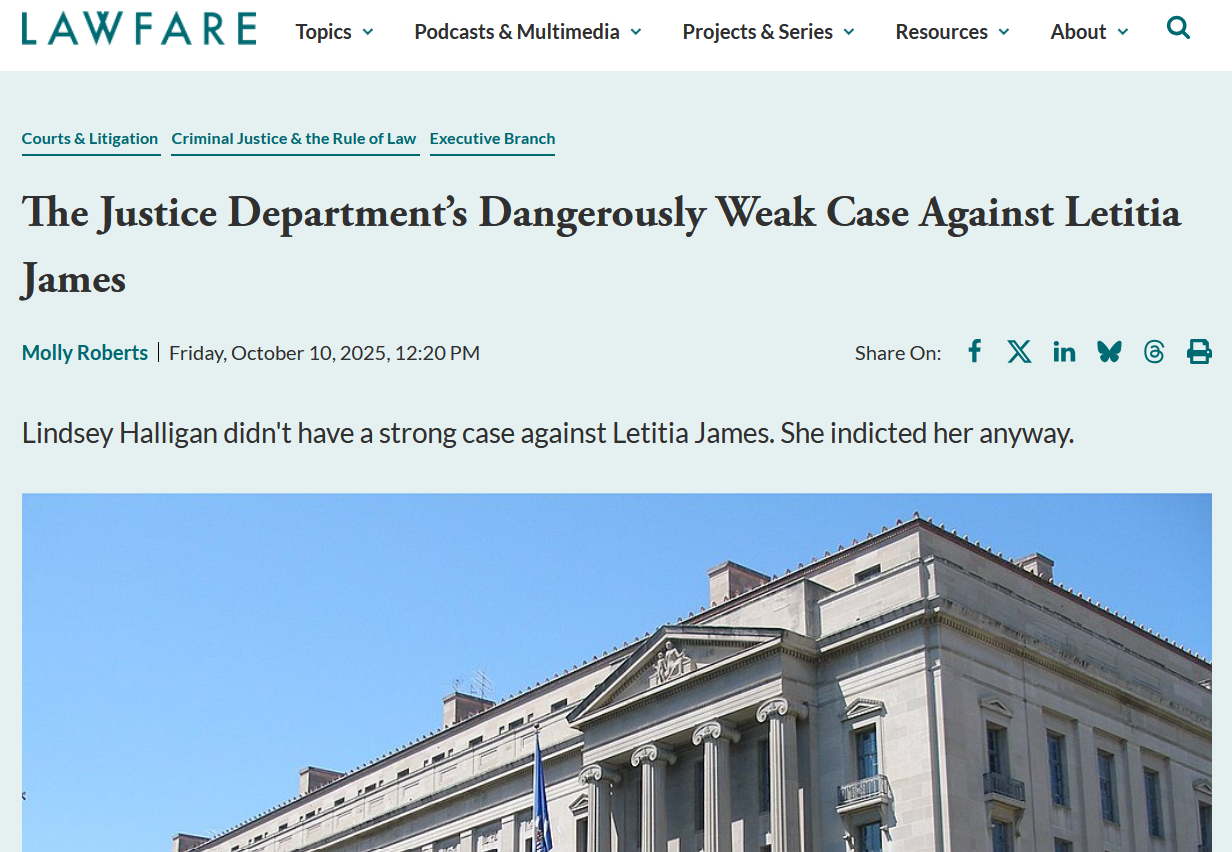
In a new analysis, Antar dismantles Lawfare’s defense of New York Attorney General Letitia James, who was recently indicted on federal bank fraud and false statement charges. The article calls the case against James “weak” and says that when James misrepresented the Virginia home as “her primary residence,” this was not false because it was a primary residence for James’s niece. The author says that to succeed, the government will have to prove that James knowingly made a false statement with intent to deceive, and that it’s going to be hard to prove intent.
Lawfare bills itself as a source for analysis of legal issues, and says it’s “thorough.” But it’s analysis of the mortgage fraud case is so flawed on basic level. Antar points out that instead of addressing the evidence, Lawfare resorted to attacking his credibility, calling him a “convicted felon” and mocking his expertise as a “fraud expert.”
His response: Yes, I’m a convicted felon. That’s exactly why I know fraud when I see it.
The article focuses on the documents at the heart of the indictment, which show four conflicting sworn statements James allegedly made about the same property:
- To the bank: Claimed it was a second home for a lower interest rate.
- To the insurance company: Reported it as owner-occupied.
- To the IRS: Reported zero personal use days and claimed rental deductions.
- To New York State: Labeled it as an investment property.
Antar points out that at least three of these statements must be false, and that the Second Home Rider she signed explicitly defines misrepresentations about occupancy as material fraud.
He also takes aim at Lawfare’s interpretation of contract language, calling it “legal malpractice dressed up as analysis.” Their argument that the mortgage rider’s requirements are “squishy,” he says, ignores plain language like “Borrower will occupy and use the Property as Borrower’s second home.”
Antar concludes that the evidence speaks for itself. Documents don’t lie. And they don’t care who finds them.
Read Sam Antar’s full forensic breakdown here: When Legal Experts Get the Law Wrong: A Forensic Deconstruction of Lawfare’s Defense of Letitia James



I would judge your article as biased, favoring a negative portrayal of Letitia James and presenting allegations in a way that leans toward expectation of guilt. Your blog on this topic functions more as an advocacy or exposé piece.
Legal and expert skepticism exists that isn’t addressed.
Several legal commentators describe the case as “legally weak,” noting that proving intent (knowing misrepresentation) is difficult.
The Lawfare site (which is a legal analysis outlet you might wish to review) describes the Department of Justice’s case as “dangerously weak” and calls out Sam Antar’s background (e.g. prior convictions) in assessing his credibility. Career prosecutors in Virginia reportedly concluded there was insufficient evidence to bring charges before being replaced.
ABC News reports that one of the forms cited in the case (a power of attorney by a relative) was never considered by the loan officers who approved the mortgage.
The role of Sam E. Antar is contested / questioned.
Sam Antar is repeatedly cited by the independent sources as a central figure in publicizing the allegations—but many reports also remind readers that he is a former convict with a controversial reputation. Lawfare explicitly notes his past role in a “massive securities scam.”
Newsweek reports that in his release of documents, James’s office was contacted for comment, implying that the story is not entirely one-sided.
Fox News reports that Antar emphasizes he “worked independently” (i.e. not under the Trump administration) to “uncover documents” relating to James.
Political context / concerns of selective prosecution:
Multiple sources raise concerns or allegations that the prosecution is politically motivated, especially given the rivalry between James and former President Trump.
There is reporting that prosecutors were pressured to bring charges despite their own lack of internal confidence.
The pattern of using mortgage fraud allegations is not unique to James — similar accusations have also been made against Senator Adam Schiff and Federal Reserve governor Lisa Cook.
The article treats Antar’s claims almost as definitive proof, rather than allegations in dispute. Independent sources treat many of his claims with caution.
It gives almost no attention to the procedural hurdles or evidentiary requirements for proving bank fraud or false statements. Independent legal commentary frequently notes those are significant challenges.
It omits much of the pushback or counter-arguments (e.g. James’s office calling the allegations “baseless”).
It downplays or ignores the political dimension discussed by other credible sources (i.e. that the prosecution may be selective or motivated).
It fails to highlight that earlier prosecutors declined to bring charges, or that some forms may not have been relied upon by decision-makers in the mortgage approval process — both are significant weaknesses in a strong prosecutorial narrative.
While Antar’s personal experience with fraud gives him technical insight, his approach violates core ethical norms that protect integrity and fairness in investigations and thus you using his ‘findings’ to state that these are ‘facts’ is a major problem.
His findings should therefore be treated as potentially informative leads — not reliable evidence until verified through independent, professionally governed channels (e.g., DOJ, auditors, or licensed investigators).
Do better.
Hi Brian!
Love the fake “Alan Potter” persona and the copy and paste from AI. A grand jury brought charges and thought there was sufficient evidence, so I’m not sure what the opinions of prosecutors have to do with this.
You’re proud to point out that Sam has a criminal past, so his work can’t be trusted. His past has zero to do with the documents and evidence. Why don’t you ever comment on the evidence? The documents themselves are not in dispute.
Sam’s approach does not violate core ethical norms. He performed an investigation and reported his results. It’s as simple as that, but rather than evaluating the facts and evidence, you prefer to criticize him personally or bring the issue back to politics.